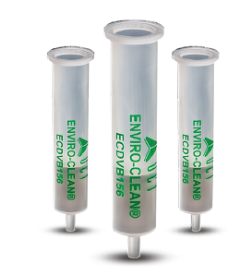

Hydrophobic phases
The most common hydrophobic phases are C8 and C18. The manufacturer offers a wide range of these cartridges with volumes ranging from 1 to 75 ml and sorbent weights of 100 to 5,000 and 10,000 mg respectively. Other phases in this group include C2, C30, phenyl and cyclohexyl.
Hydrophilic phases
Hydrophilic sorbents consist of a silica base bonded to carbon chains containing polar functional groups. Examples of phases with this functionality include pure silicon dioxide, diol and cyano-propyl phases. Compounds are retained on hydrophilic sorbents via polar interactions, including hydrogen bonds, π–π or dipole–dipole interactions. These types of interactions occur when the distribution of electrons between individual atoms in functional groups is unequal, resulting in negative and positive polarities. Polar-functionalised bonded silicas and polar adsorption media are typically used under normal-phase conditions.Anion-exchange phases

Cation-exchange phases
Designed for the removal of cations (e.g. metal cations, amines, ammonium compounds). They are often used to purify solutions of ions that cause water hardness (e.g. calcium, magnesium) or to remove unwanted cations.Copolymer

Polymeric DVB sorbent