


The model has a resolution of less than 0.05 nanometres, which is approximately one million times smaller than the thickness of a human hair. The Spectra Ultra is one of the most advanced aberration-corrected microscopes in the US national laboratory network.
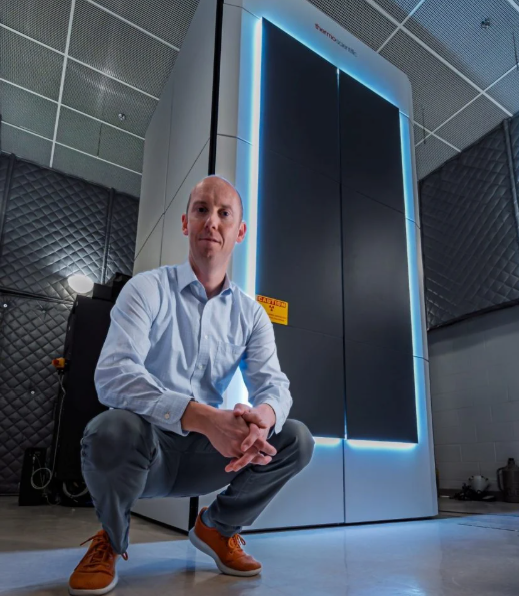
David Cullen of Oak Ridge National Laboratory (ORNL) standing next to the new Thermo Scientific Spectra Ultra scanning transmission electron microscope
However, the instrument’s main advantage lies not only in the precision of the images, but also in the speed and flexibility of the analysis.
Flexible configuration
The accelerating voltage can be adjusted, so operating conditions are selected to suit the sensitivity of the sample, thereby reducing the risk of damage.
Comprehensive analysis
The microscope combines imaging and spectroscopy, allowing researchers to simultaneously visualise the atomic structure of the material and its chemical composition.
AI-based automation
Artificial intelligence algorithms help to automate sample handling, identify areas for further investigation and process the data obtained.
Where it will be needed:
Aviation and mechanical engineering. Developers will be able to determine why one lightweight alloy retains its strength after years of heat, vibration and stress, whilst another weakens. This is critical for the creation of reliable components.
Electric motors. The instrument will reveal the arrangement of critical minerals within permanent magnets and help identify high-temperature-resistant substitutes. This reduces production’s reliance on scarce raw materials.
Chemical industry. The microscope will speed up the search for stable catalysts for the more efficient production of alternative fuels and other chemical products.
Thus, Thermo Scientific electron microscopes not only enable a better understanding of the properties of modern materials, but also help to find ways to improve the technologies used in their production and application.
Ukrainian research institutions and enterprises can also benefit from Thermo Fisher Scientific’s cutting-edge transmission electron microscopy technologies. Such solutions make it possible to investigate the internal structure of materials at the nanoscale: crystal lattices, defects, nanoparticles and thin films.
This opens up a wide range of opportunities for research in the fields of materials science, nanotechnology and biomedicine.
You can find out more about the capabilities of transmission electron microscopy and how to choose the right instrument on the catalogue page.
Sources: